

If you opened this link hoping to read about felines, we must apologise at the onset. However, if you are curious as to how cat may be translated in perhaps all languages on various softwares, you are at the right place. We are talking about CAT Tools - Computer Aided Translation Tools!

Simply explained, CAT Tools such as Trados Studio, MemoQ and SmartCAT, are softwares that facilitate the process of translation for a human translator. While it may be nearly impossible to trace the history of practice to translation from one language to the other, CAT tools can be followed all the way back to the Cold War, a time when the collected information had to be translated without any delay. This immediate need, for the first time, saw not only intense research but investment too in translation technology. Warren Weaver who coined the term Machine Translation was aiming towards an automatic translation program. Later, an American researcher, Toma created something of this sort called Systran (System Translation). However, in subsequent years, it was suggested that rather than creating an automatic translation system, a system that facilitates the work of human translators should be developed. And since then, in these last 40-50 years or so, CAT tools have significantly altered the way translators work and manage their assignments. A computer-assisted translations tool can provide much needed assistance when translating texts of considerable sizes. It effectively aids the translator in the processes involving correct use of terminology, maintaining consistency and proofreading.
CAT Tools today represent a wide range of assistive tools, which may extend from something as basic as Spell Checkers to Electronic Dictionaries, from Memory Tools to Translation Management softwares. And these softwares can be classified into many different types based on their concept . Easiest way to understand how a CAT software works is to simply know that it breaks the source text into smaller units called translation units or segments (TUs for short). Then it creates a database where it stores all the sources and their translations. And with the help of translation memory, the tool assists a translator to maintain consistency in terminology and writing style.
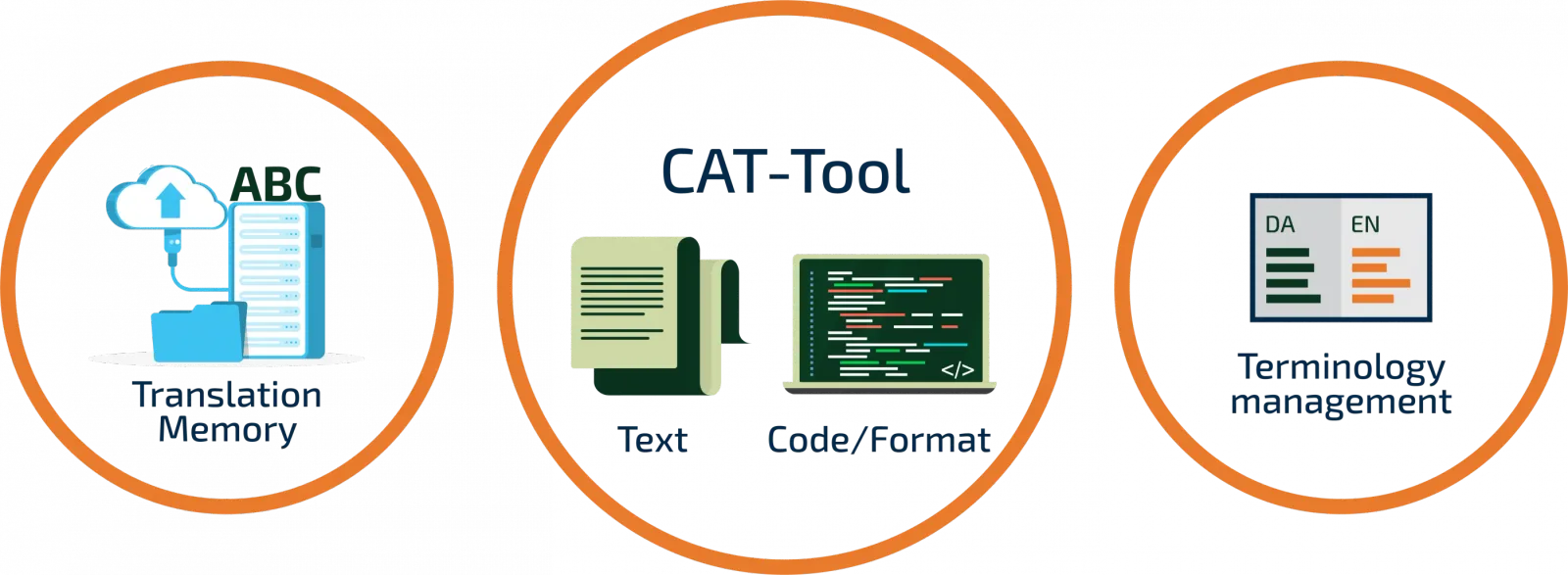
While the most evident advantage of these tools is that they save a great deal of time, one can count a few more benefits off the fingers. They also enhance the efficiency of the translators. When using these tools, it immediately becomes clear which parts of the text must be translated, based on that, the unchanging portions are transferred accurately and directly. Needless to say, the time savings due to repeating expressions is huge and expressions are translated consistently.

Another advantage of most CAT tools is that they let the translator work with formats other than Word (Excel, PowerPoint, Visual Studio, Java, HTML, XML, etc.) without modifying the format. In files created in a tagged language or which have special page breaks, the CAT tool leaves the layout unchanged, which allows the translator to focus exclusively on the translation.
Furthermore, another common feature of many CAT tools is the creation of easily and rapidly retrievable terminology cards. Most translators had to work with terminology cards and glossaries. CAT tools allow the creation of a correct terminology database, which along with the expression in the source and target languages, also stores the context, examples, and images. What’s more - you can easily customise the categories provided for describing the expressions.

However, CAT tools, like most computer programs, have their shortcomings and limitations. And although a considerable progress has been made in this technology, it is difficult to guarantee their trustworthiness as of now. Of course, one of the major reasons for why a software doesn’t function as per the expectations is also the user’s inadequate familiarity with it. Learning these programs requires time, especially if the translator wishes to make use of all available resources. This is how almost all CAT tools work. So how did EZ Works bell the CAT?
First, we used everything that was available in the market. But we realised that all the CAT tools available had their own limitations. Either they did not support the size of the translations that we were doing, or they did not permit collaborative work on a single assignment. So, we decided to make our own CAT tool - a browser based version that allows for collaboration and significantly enhances information security. With the kind of clients we have, information security was an essential point to consider. And thus, we worked towards our own browser based CAT tool - EZ Translate. Moreover, the tools that we developed allowed multiple people to work on the same assignment without diluting its quality. Our in-house CAT Tool played a vital role in making us faster than the fastest and in letting us deliver consistently high quality work.