OCR or Optical Character Recognition/Reader is the electronic or mechanical changeover of images of texts, be it typed, handwritten, or scanned, into machine-encoded text. It is a technology that sits at the conjunction of Computer Vision or Machine Vision and Natural Language Processing. While Computer vision helps us to detect texts, Natural Language Processing enables us to recognize texts. With technological innovations and developments entering new avenues every day, OCR has found its applications in various fields. Read the article to know more about OCR, how it was created, its types, functions, and more.
Timeline of Developments that led to the creation of OCR
It was during the early 20th century, the 1920s, to be precise, when Fournier d'Albe's Optophone and Tauschek brought OCR into existence. Its initial conception can be traced to the creation of a device that could read texts for blind people. Given below is a timeline of developments that brought OCR into existence.
| 1870–1931 | Ideas of OCR were conceived. Reading Machines were developed to help the blind read |
|---|---|
| 1931–1954 | First OCR tools were invented, which were able to interpret Morse code , and read out the text aloud. Intelligent Machines Research Corporation became the first company to sell such tools. |
| 1954–1974 | Optacon , the first portable OCR device, was developed. Similar devices were used to digitise Reader’s Digest coupons and postal addresses. Special Typefaces were designed to facilitate scanning. |
| 1974–2000 | Scanners were massively used to read price tags and passports. Companies like Caere Corporation, ABBYY and Kurzweil Company Products Inc were created. Kurzweil Company Products Inc developed the first OCR software, capable of reading any text document. |

Types of OCR
OCR can be categorized into four broad types, which are given below:
- Optical Character Recognition: It targets typed and written texts, one character at a time.
- Optical world Solution: It spots typed and written texts, one word at a time. It is used for languages that use space as a word divider.
- Intelligent Character Recognition: It targets script or cursive texts, one character at a time.
- Intelligent Word Recognition: It targets handwritten cursive texts, one word at a time.
How does OCR function?
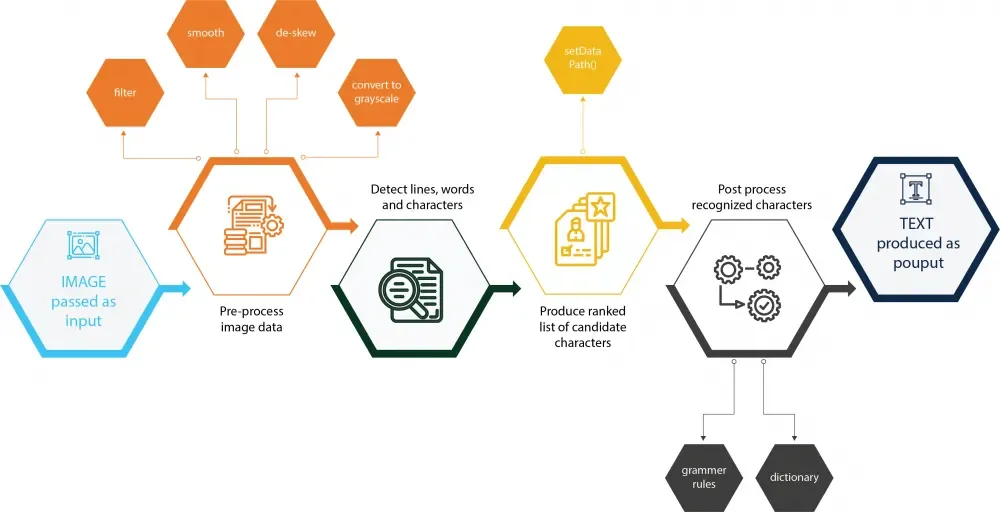
OCR functions in four stages, which are, pre-processing, text-detection and recognition, post-processing, and application-specific maximization.
Stage 1: Pre-processing
- This stage aids the process of recognition of characters.
- The images are checked for defects, like distorted text lines, skewed images, noises, and more.
Stage 2: Text detection and recognition
- Each character is assigned possibilities, which match the graphic symbol.
- It has traditional core algorithms, like SVM, HMM, CNN (Convolutional Neural Network), and RNN (Recurrent Neural Network), which present a list of prospective characters.
- The ensemble of multiple models, such as CNN + HMM and CNN + LSTM lead to significant enhancement in the quality of the OCR output.
Stage 3: Post-processing
- This stage aims at correcting the OCR mistakes, thereby, increasing the accuracy of recognition.
Results obtained from the OCR system do not usually match the original document. The post-processing stage, therefore, helps in processing the obtained results.
- It modifies the input sequence of characters to match with another sequence of characters, which is graphically similar and generates the maximum likelihood of the sentence from the given language models.
- Joint probability distributions maximize the conditional probability of OCR output, with a given likelihood of observing that sequence.
Stage 4: Application-Specific Maximization
- OCR is tweaked to deal with more specific inputs.
- This step brings contextual awareness (high-level lexicons) to our OCR, based on our custom client preference and specification.
Applications of OCR
OCRs have become an integral part of life, so much so that we use them without even realizing it. Some of the common applications of OCR are given below.

- Automatic number plate recognition
- Assistive technology for visually impaired users
- Document scanning and conversion into searchable PDFs
Use of OCR in EZ
- We, at EZ, are working relentlessly to update our OCR in accordance with other technological developments that define the task of translation.
- We strive to create our own OCR algorithm that works seamlessly with languages, like Arabic, which has an additional challenge of diacritics and is written right to left.
- We are also working towards improving image preprocessing, using Artificial Intelligence algorithms, for Computer Vision.
- Our EZ Lens system is capable of enhancing the image quality from a low fidelity image to a high-quality one.
- We have set a threshold at which our OCR works. Any image that falls below that, needs to be reworked upon, such that it qualifies the standards that our OCR has set.
- We ensure that our OCR produces great output, even on low-quality input, such as poor quality scans or washed out paper records.
- We have trained our OCR on a large proprietary dataset, to build better character and word recognition than any other Arabic OCR in the world.
- We have brought appreciable enhancement by working on some new and pathbreaking technological development, which will take our OCR technology to another level of application altogether.