
Recent studies show that only 24% of organizations can handle a distributed workforce well. This reveals a major gap in cross-border leadership readiness. Teams that communicate well internally see their productivity rise by up to 25%. Still, leading teams that follow cross border leadership brings its own set of challenges.
The Gulf Cooperation Council (GCC) is becoming an important business hub due to the Saudi Vision 2030, UAE's economic diversification, and Quatar's investments. This rapid growth results in an increasingly diverse workforce and makes cross border leadership imperative for today’s managers.
Managing multi-national teams comes with a set of challenges including cultural nuances and legal prerequisites. It takes a unique brand of leadership, competency, culture and technology to maximize the effectiveness of a unit operationally and culturally in this environment. However, as every process comes with its own difficulties, Let’s have a detailed look at the key challenges that’s seen in 2025.
Key Challenges of Managing Multinational Teams in 2025
Managing multinational teams with a cross border leadership approach comes with unique challenges that need careful attention and practical solutions.
Cultural & Communication Barriers
Cultural differences shape how teams communicate and make decisions. Some cultures prefer direct communication and quick decisions, while others lean toward indirect approaches and building consensus. Team success often faces roadblocks due to institutional differences and limited informal communication. Leaders must navigate differences in business etiquette, communication styles, and workplace expectations.
Differences in Regulatory & Labor Law
The labor laws pertaining to employee contracts, benefits, and conflict resolution differ in every GCC country. Decisions in hierarchical cultures come from top management with little input from below. On the flip side, flat organizations encourage everyone to participate in decision-making. Leaders must manage reputational risk while ensuring that these rules are followed and that there is a blended organizational culture.
Complications In Remote & Hybrid Work
As more organizations adopt hybrid work, there is a need for coherence of teams working in different locations and time zones. It is important to keep the team running on the same page without any misunderstandings. It requires a certain level of digital competence to manage performance, collaboration, and engagement in such scenarios.
Employee Inclusion & Engagement
As it sounds, it is highly important to make the employees feel safe and secure. The most important task among all would be to make them feel included irrespective of who they are, and where they are from. Creating a sense of belonging among diverse employees is crucial. Differences in work ethics, management expectations, and career aspirations necessitate a cross border leadership approach that values inclusivity and adaptability.
The GCC region faces its own set of challenges. Most organizations run on an unofficial seniority system instead of pure merit, which makes building effective work teams difficult. These might not only degrade the employees but would also result in a bad organisational reputation.
Managing the mix of expatriate workers and local talent while dealing with visa rules adds extra complexity to team leadership.
Best Practices for Effective Cross Border Leadership
Trust is the life-blood of successful cross border leadership. Leaders need effective strategies to guide teams across cultural boundaries.
Leaders who demonstrate cultural intelligence are making a significant difference. Studies reveal that their teams show 30% higher performance rates. Managers with strong cultural awareness create environments where trust and cohesion thrive within three months of team formation.
Here are 3 proven approaches will help you excel in cross-border leadership:
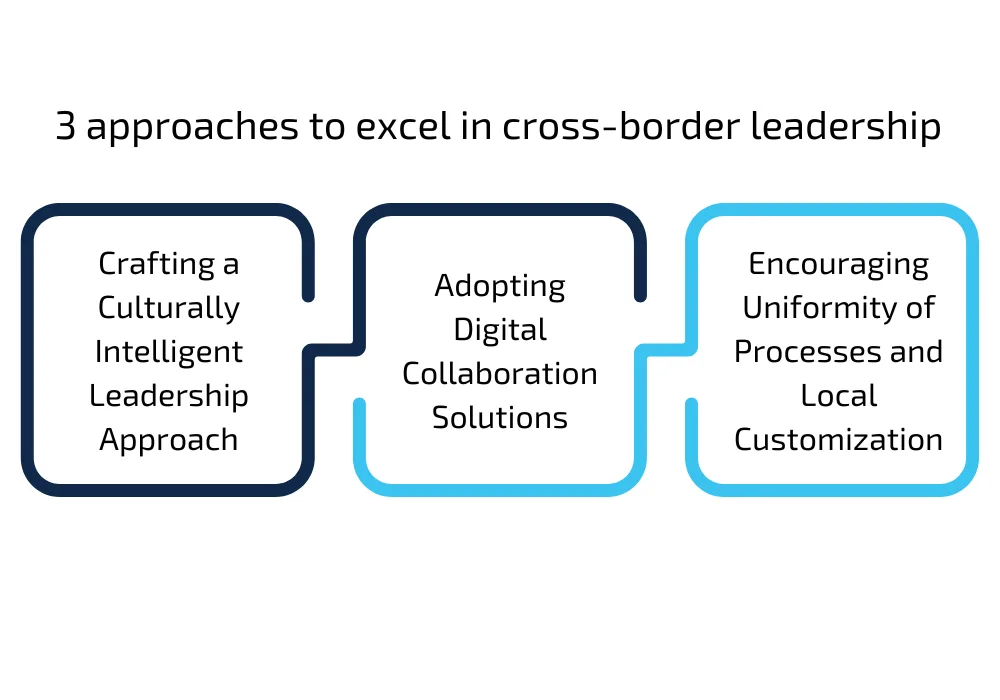
- Crafting a Culturally Intelligent Leadership Approach: Cultural intelligence (CQ) helps leaders appreciate local values and facilitate international cooperation. Cultural differences, when understood and carefully integrated into a leadership style, help in establishing trust and increased engagement among team members.
- Adopting Digital Collaboration Solutions: Technology helps eliminate borders. The use of AI project management tools, simultaneous translation tools, and virtual team-building events helps multi-national teams to work together effortlessly.
- Encouraging Uniformity of Processes and Local Customization: An organization cannot be too global or too local. Standard operating procedures (SOPs) are required to be implemented consistently across countries but some local adjustments need to be made.
Essential Tools & Technologies for Seamless Multi-National Team Management
The right technology stack plays a significant role to maintain smooth operations across geographical boundaries.
- Project Management Solutions: Project management systems combined with cooperation tools create streamlined workflows. Teams get centralized platforms to access project updates, timelines, and task assignments. BasicOps offers a minimalistic interface that simplifies task-based discussions and ensures clear project responsibility tracking.
- AI-Powered Leadership Tools: Organizations show a 50/50 split in AI adoption. Some lead integration efforts while others test proof-of-concept stages. Tools like Leapsome analyzes employee performance and engagement data to generate practical insights and individual-specific plans. AI-powered cooperation tools sync schedules, provide instant updates, and analyze team sentiment to spot potential roadblocks.
- HR Management Systems: Global digital environments make data privacy protection vital. Cross-border data flows drive economic growth, yet different regulations create challenges. HR software helps manage remote workforces through attendance tracking, performance monitoring, and compliance tools for different GCC countries' labor laws. These systems offer secure platforms that manage sensitive HR data and reduce breach risks.
Case Studies

Many multinational companies have shown remarkable success leading cross-border operations in the GCC region.
Example 1: TruKKer (UAE)
Founded in the UAE, TruKKer has rapidly expanded into Saudi Arabia and other GCC countries, leveraging AI and machine learning to optimize routes and reduce shipping costs. Their focus on AI-driven customer service solutions and adaptive team structures helped them scale operations seamlessly.
Example 2: Saudi Aramco (Saudi Arabia) – Energy & Petrochemicals
Saudi Aramco operates as one of the world’s largest oil and gas producers, leading in energy investments, refining, and petrochemical projects worldwide. By balancing global strategies and proven efficiency,they have ensured both compliance and cultural relevance are met.
Example 3: GitLab
GitLab is one of the largest all-remote companies, with over 2,000 employees in 65+ countries. They have a transparent documentation, asynchronous communication, pattern that runs within the team. By leveraging AI-powered project tracking and regular virtual check-ins, they maintained productivity while ensuring employee satisfaction.
What makes EZ your extended team for Cross Border Leadership Excellence
As investments in the education sector continue to grow across the GCC region, so do the expectations of its ambitious and dynamic youth. At EZ, we’re not just responding to this shift - we’re leading it. Our holistic development frameworks and clearly defined career trajectories are designed to meet the aspirations of the new generation, while addressing the region’s distinct cultural and economic dynamics.
With over 70+ tailored offerings, we stand at the forefront of sustainable growth. We understand that in today’s rapidly evolving market, the key to success lies in strategic collaboration and future-focused talent management.
Tailored Solutions. Measurable Impact.
At EZ, we go beyond conventional practices. Our solutions are crafted to optimize efficiency, boost productivity, and drive long-term success. Our signature 10-20-30 rule — backed by real-time monitoring and expert-led systems — ensures we remain laser-focused on delivering results that matter.
Round-the-Clock Support. Innovating with AI.
We don’t just keep up with technology — we embrace it. Our clients benefit from our round the clock availability, delivering consistently high-quality outcomes, and a proven track record of technological agility. It’s no surprise that leading organizations choose EZ to stay ahead in an increasingly competitive landscape.
Wrapping Up
To lead teams in different countries requires a blend of cultural understanding, technology, and agile management competencies. The success stories from the GCC region demonstrates however, that greatness is achievable with the right strategy.
As time goes by the significance of cross border leadership will increase greatly for GCC organizations. The period to create cultural awareness is now. Adapt technology that enables remote teams and empower more flexible styles of leadership. Effective cross border leadership is more than managing teams; it is opening doors through which talent can come in and enable development across the GCC region.